
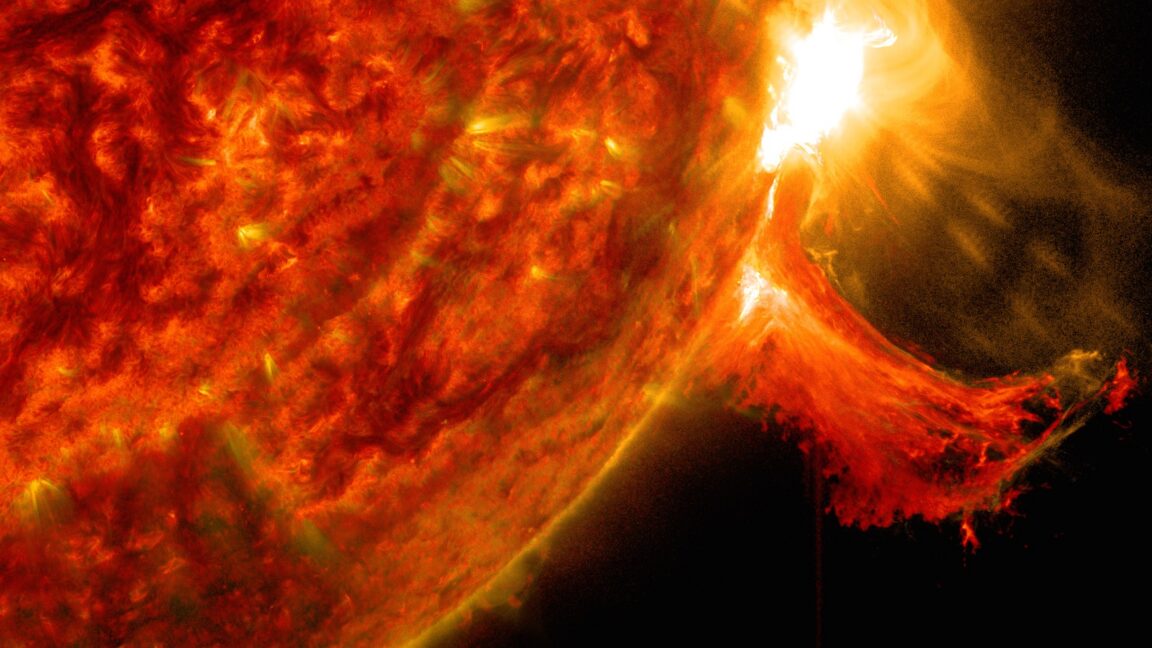
**Summary: NASA Delays Mars Mission Launch Due to Powerful Solar Storm**
NASA has postponed the launch of its twin Mars-bound ESCAPADE spacecraft, originally scheduled to lift off from Cape Canaveral Space Force Station in Florida this week, due to heightened solar activity. The decision comes after a series of intense solar eruptions sent waves of charged particles toward Earth, creating not only spectacular auroral displays but also raising concerns about the safety of spacecraft and satellite operations.
**A Solar Storm Disrupts Launch Plans**
The launch was to be the second flight of Blue Origin’s New Glenn rocket, a significant milestone for the company founded by Jeff Bezos. The heavy-lift vehicle was ready on the launch pad, and Blue Origin planned to recover its reusable first-stage booster after liftoff. However, as Earth was enveloped by a supercharged wave of magnetized plasma from the Sun, NASA made the call to hold off on launching the mission until space weather conditions improved.
Blue Origin issued a statement via social media, confirming the postponement and explaining the rationale. “New Glenn is ready to launch,” the company wrote. “However, due to highly elevated solar activity and its potential effects on the ESCAPADE spacecraft, NASA is postponing launch until space weather conditions improve. We are currently assessing opportunities to establish our next launch window based on forecasted space weather and range availability.”
**Risks Posed by Solar Activity**
Solar storms, like the one currently impacting Earth, can have serious effects on technology both in space and on the ground. When the Sun releases energy in the form of coronal mass ejections (CMEs) — huge bursts of charged particles and magnetic fields — these can interact with Earth's own magnetic field. The results can include disruptions to communications, navigation systems, power grids, and, crucially for this mission, satellite electronics.
While it is rare for rocket launches to be delayed due to space weather, it is not without precedent. For example, in 2014, the launch of an Antares cargo rocket to the International Space Station was postponed for a day because of heightened solar activity. More recently, SpaceX delayed a Falcon 9 launch in 2023 for several hours due to concerns about space radiation, following an incident in 2022 where a geomagnetic storm caused nearly 40 Starlink satellites to re-enter the atmosphere prematurely.
For the ESCAPADE mission, the main concern is not increased atmospheric drag—since these probes are heading for deep space rather than low-Earth orbit—but rather the risk that high-energy solar particles could interfere with the spacecrafts’ sensitive electronics. The irony is that ESCAPADE’s primary science objective is to study how the solar wind interacts with Mars’ upper atmosphere, yet its own journey is now endangered by the very phenomenon it seeks to investigate.
**No New Launch Date Set**
Blue Origin did not immediately announce a new target date for the launch. The schedule at Cape Canaveral is crowded, with several other